First-Time Founders in India: Business Ideas That Need a Bank Loan, the Ones That Don’t, and How AI Helps You Decide
Every week someone asks me the same thing in a slightly different way. “Siva, should I take a loan or not?” Sometimes it comes after a long message about savings. Sometimes it is one line at 1 AM. And every time, my honest answer starts with another question: what kind of business is it?

Because the loan question has no single answer. Some business ideas that need a bank loan simply cannot start without one. Others are hurt by a loan they never needed. The mistake is not borrowing or refusing to borrow. The mistake is picking a side before you know which kind of business you are running.
Half the founders I meet treat debt like fire. They bootstrap everything, even when the business is starving for stock. The other half take the first loan a bank offers and then discover the repayment date does not care about their slow months. Both groups are right about something. They are just right about different businesses.
So in this one, I am going to sort that out properly. Which ideas genuinely need capital, which ones grow fine without it, what an MSME loan application really asks for, and the part I now do with every founder before they sign anything: running the numbers through AI to see the bad months before they arrive.
What we settle before you sign anything
Why Business Ideas That Need a Bank Loan Are a Different Species
Capital need is not a personality. It is a property of the business. Some businesses can grow on reinvested profit, slowly and patiently, with no outside money ever touching them. Others have a structural need for money upfront that profit simply cannot supply fast enough, however patient the founder is.
Get the category wrong in either direction and it costs you. Bootstrap a business that needed capital and you spend years undersized while a better-funded competitor takes the market. Borrow for a business that never needed it and you carry an EMI for a machine, a shop fit-out or a stock pile that never earns its keep.
A loan is a tool for a structural problem. It is a terrible solution for an emotional one.
I wrote earlier about money in the first six months of a small business, and the pattern there applies here too. The money problems that kill small businesses rarely show up on day one. They show up in month three, when the repayment schedule meets real revenue for the first time.
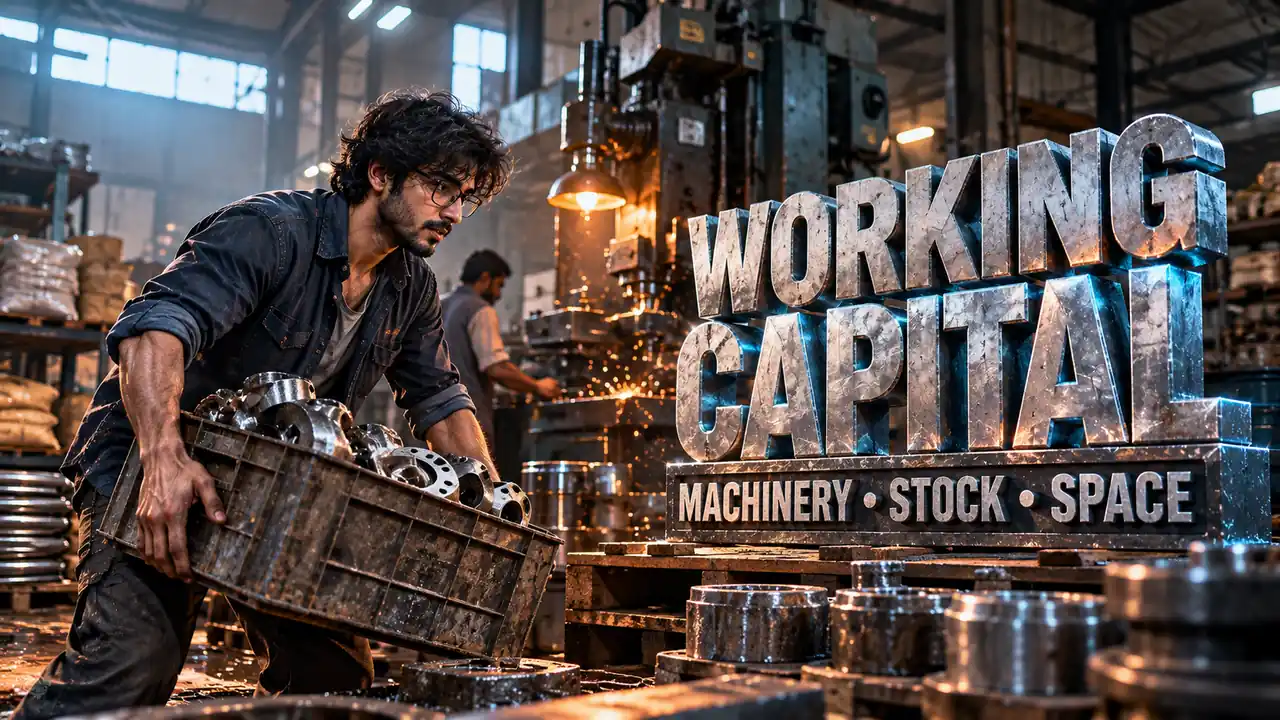
Business Ideas Requiring Working Capital or Machinery
- Small manufacturing or assembly units. Machinery, raw material in bulk and a working space must exist before the first unit sells. There is no order of events where profit from units pays for the machine that makes them. This is where MSME loan business ideas in India genuinely earn their keep.
- Inventory-heavy retail and wholesale. Buying stock in quantities that give a healthy margin needs money sitting on shelves before a single sale. A shop that can only stock what last week’s sales paid for stays permanently smaller than the one that financed proper stock.
- Businesses with a real seasonal cash gap. Agriculture-linked trade, festival retail, anything where most of the year’s money arrives in a few weeks but costs run all year. Business ideas requiring working capital in this group rarely survive without a bridge.
Business Ideas With No Bank Loan Needed
- Service businesses built on your own skill. Consulting, freelancing, tutoring, design, website builds. The real capital is your time. A loan here usually funds lifestyle spending dressed up as business investment.
- Small-batch products scaled slowly. Food, crafts, anything where batch size can grow in step with real demand. These are low investment business ideas with no debt, as long as you resist scaling faster than orders justify.
- Digital and content businesses. Social media management, small-scale reselling, content work. The startup cost is roughly your phone and internet bill. If you want to run social media for local clients, my piece on AI social media automation shows how much of the repetitive work AI can carry now.

| Business type | Typical capital need | Loan dependency |
|---|---|---|
| Service or consulting business | Mostly time, very little money | Low, rarely needs a loan |
| Small-batch product, scaled slowly | Modest, grows with demand | Low to moderate |
| Inventory-heavy retail or wholesale | High, needed before sales | Moderate to high |
| Small manufacturing or assembly unit | High and structural | High, usually needs a loan |
Bootstrapped Business Ideas vs Funded Ones: One Idea, Two Paths
Here is the comparison I use when a founder is stuck. Picture two people in Pune starting the same packaged snack business in the same month, at the same price.

The first one bootstraps. She cooks small batches in her own kitchen, sells at weekend markets and housing society stalls around Wakad and Hinjawadi, and puts every rupee of profit back into slightly bigger batches. By month six she has grown steadily, slowly, and she owes nobody anything.
The second one takes a loan early. She finances proper kitchen equipment and a first production run sized for real demand. By month six, if she sized the loan against honest demand and not hope, she is selling several times more than the first founder, and her EMIs are covered comfortably by the bigger revenue.
Neither of them made the smarter universal choice. Each made the choice that fit her evidence. If you are unsure about demand, the first path protects you. If you already have proof, say from a smaller version that sold out every weekend for six months, the second path lets you use that proof before a competitor does. Bootstrapped business ideas vs funded ones is rarely about two different ideas. It is usually the same idea at two different confidence levels.
And a third founder, running a consulting practice on her own skill, never faces this choice at all. Her capital need is close to zero however confident she is. Knowing which of these three you are is the real skill here.
A Small Business Loan vs Self Funded Business: The Year That Follows
The decision to borrow is only the first of many. Here is how a year usually unfolds on each path.
| Stretch | Business that borrowed | Business that stayed self-funded |
|---|---|---|
| Month 1 | Loan clears, machinery or stock arrives, the business suddenly runs at a scale savings could never fund. It feels deceptively good. | Proving the model at small scale. Looks the same whether a loan was ever on the table or not. |
| Months 2 to 4 | The most dangerous stretch. Repayment meets real revenue. A loan sized on optimistic projections starts to pinch around the third EMI. | Growth is capped by last month’s profit. Frustrating, but a bad month costs momentum, not a missed EMI. |
| Month 6 | A visible return on the capital should exist by now. If it doesn’t, investigate where the money went before blaming the loan. | Smaller than the financed version, but carrying zero debt risk. |
| Months 7 to 12 | A correctly used loan compounds its advantage. Time has a cost too, and financed growth can beat patient growth by a wide margin. | Steady, safe, and sometimes too slow if real demand was waiting. |
The Small Business Loan vs Self Funded Business Mistake That Sinks First-Time Founders
The worst loan stories I have heard are never about the interest rate. They are about a repayment schedule that did not match the business’s cash rhythm. Picture a founder who took a machinery loan for a product with thin, seasonal demand. The machine sat idle more months than it ran, and the EMIs did not pause for the idle months.
It got worse because the founder did not go back to the lender. Months went by with payments scraped from personal savings, turning a business problem into a family problem. When the founder finally sat down and explained the seasonal pattern honestly, the lender restructured the repayment to match the months when money actually arrived. One conversation. It could have happened four months earlier.
Remember this: a mismatch between your EMI schedule and your cash rhythm is a structural problem with a structural fix. It is not a personal failure to be absorbed quietly. Raise it early. Lenders deal with seasonal businesses all the time. And if costs outside your control are squeezing you, like the way fuel prices hit small businesses in India recently, say that too. Lenders read the news.
There is a quieter version of the same mistake: borrowing the right amount for the wrong asset. Using a short working capital line to buy a machine that lasts ten years means repaying faster than the machine earns, and every month’s cash flow feels the squeeze for no reason. Match the loan type to the purpose, not only the amount to the need.
MSME Loan Business Ideas in India: What the Application Really Asks
For business ideas that need a bank loan, the process is far more approachable than its reputation. Here is what actually sits behind the schemes people mention.
- Udyam registration comes first, almost always. It is free and online, and it gives the business the formal identity a lender wants to see before any conversation about credit. Udyam registration loan eligibility starts from this foundation whatever scheme or bank is involved.
- PM Mudra Yojana covers small non-farm businesses in categories called Shishu, Kishore and Tarun. The ceiling was doubled to ₹20 lakh in October 2024 through a new Tarun Plus category for borrowers who have taken and repaid an earlier Tarun loan.
- CGTMSE provides credit guarantees so that eligible micro and small enterprises can get loans without pledging property. If you have no collateral, ask specifically whether your loan can be covered under it, before you assume a bank will demand security.
- SIDBI finances machinery, working capital and term loans for small units, often through partner banks rather than directly. Many MSME loan schemes for new business ideas trace back to it, even when the money is disbursed by your local bank branch.
- NSIC runs raw material support and a registration scheme that opens government procurement as a buyer, which matters once a manufacturing unit is producing at scale.
The document list is shorter than people fear: the registration certificate, identity and address proof, bank statements, and a plain written explanation of what the money is for and how repayment works. What slows an application down is rarely a missing form. It is a founder who cannot explain their own repayment maths when the officer asks one direct follow-up question.
Udyam Registration Loan Eligibility, in Plain Words
People ask me whether Udyam registration by itself gets them a loan. It does not. What it does is make you visible to the system. A registered micro or small enterprise can be considered for priority sector lending and for schemes an unregistered business simply cannot enter. Udyam registration loan eligibility is about access and priority far more than about the headline interest rate.
Two things surprise first-time founders. First, the registration is free, and the official portal itself warns people about websites that charge for it. Second, retail and wholesale traders can register too, for priority sector lending purposes. So a shop owner who assumed MSME schemes were only for factories should look again. Register early, keep your bank statements clean, and by the time you need credit, you will have a history to show.
What Happens in the Loan Officer Meeting
It is less adversarial than first-time applicants expect. The officer’s job is to judge repayment capacity, not your character. The questions are almost always the same: what is the money for, what revenue exists or is realistically expected, what security or guarantee is available above a certain amount, and how the repayment lines up with your cash pattern. Founders who walk in with honest answers, including the downside case, have smoother meetings than founders who walk in with a pitch deck. Confidence plus honesty about risk reads as creditworthy. Pure optimism reads as a warning.
How I Use AI to Stress-Test Business Ideas That Need a Bank Loan
This is the part I now do with every founder before they sign. Not because AI decides for you. It does not, and it should not. But it is the fastest way I know to see the bad months on paper before they happen in real life.

- Write down your real numbers first. Monthly fixed costs, expected revenue for twelve months, the loan amount, the interest rate you were quoted and the tenure. AI cannot fix guesses. It only multiplies them.
- Ask for three scenarios, not one. I type something like: “Here are my costs and expected revenue. Build a 12-month cash flow table with an EMI of this amount. Then show the same table if revenue comes in at 70% and at 50% of my estimate. Tell me in which month cash goes negative in each case.”
- Add your seasonality. “Most of my sales come in October and November. Redo the tables with that pattern and show whether a step-up or seasonal repayment schedule would fit better than equal EMIs.”
- Ask it to argue against you. “Act like a strict loan officer. List the five questions you would ask me about this plan and the weakest assumption in it.” This one alone has saved founders from embarrassing meetings.
- Check every number yourself. Open the table in a spreadsheet and recalculate the EMI and totals. AI tools are good at structure and occasionally careless with arithmetic. The bank’s figures are the ones that count.
A Prompt You Can Copy for Your Own Loan Check
I run a [type of business] in [city]. My fixed monthly costs are Rs [amount].
I expect monthly revenue of Rs [amount] for the next 12 months, with these seasonal peaks: [months].
I am considering a loan of Rs [amount] at [rate]% for [tenure] months.
1. Build a 12-month cash flow table with the EMI included.
2. Repeat it at 70% and 50% of my expected revenue.
3. Tell me the first month cash goes negative in each case.
4. Suggest whether equal EMIs or a seasonal/step-up schedule fits my cash rhythm better.
5. Act like a strict loan officer and list the five toughest questions about this plan.
Fill in your own numbers, run it, and then recheck the maths in a spreadsheet. Run it again when anything changes: a new supplier price, a slow festival season, a rent hike. A small business loan vs self funded business decision deserves fresh numbers every time, not the excitement of the day you first had the idea.
If you are comfortable going one step further, you can build this as a small reusable tool on your own laptop. My Claude Code beginners guide walks through that from zero, and the Claude cheat codes and slash commands list saves a lot of typing once you are inside it. For founders who want something that runs on its own every month, the AI agents guide for solo founders shows what an agent can watch for you, and the Claude computer use tutorial explains how an assistant can work directly with files on your machine.
One honest warning, because I see the hype every day. AI will not find you a loan, negotiate your rate or make a weak business strong. As I wrote in AI agents market saturation, most of what is being sold as magic is a thin layer over the same few tools. Use it as a calculator with a good memory and a sharp tongue. Nothing more.
Low Investment Business Ideas With No Debt: When Staying Bootstrapped Wins
Ask one honest question before anything else. Can this specific idea reach a sustainable, profitable size purely through reinvested profit, on a timeline you can actually live with? If yes, bootstrapping is almost always the better path. No repayment pressure while the business is still proving itself, and a bad month costs you momentum, not an EMI.
These are the business ideas with no bank loan needed in their DNA. Many of the best business ideas for small towns sit firmly in this group: services, small-batch food, repair work, tuition, local digital services. They grow into something real through patient reinvestment and never touch a loan. If your idea fits here, the most useful thing you can do is protect your personal reserve and keep costs honest.
And the switch is not permanent. A business that started bootstrapped can take sensible debt once it has six months of proof. A business that started financed can prepay once cash allows. The founders I respect most revisit this decision every few months instead of locking it in at launch.
A Checklist Before You Apply for MSME Loan Schemes for New Business Ideas
- Is the business registered? Udyam at minimum, and Startup India recognition if you are an incorporated startup or LLP that qualifies. A formal identity changes how seriously every answer is taken.
- What is the itemised use of the money, line by line, not a round number?
- What does a realistic, not optimistic, six-month revenue picture look like, and does it cover the EMI with room to spare?
- What happens to the business and to you personally if revenue comes in at half the realistic number?
- If turnover is heading towards the GST threshold, are you registered on the GST portal? A lender reading your bank statements treats GST-registered, trackable revenue as a good sign.
- Have you put your own stake in? Most schemes expect the founder to carry a real share of the project cost. Skin in the game changes how carefully people spend.
If you can answer all six plainly, with real numbers, your business is ready for the loan conversation. If not, close the gap before you apply, not during the meeting.
One Last Word on the Discomfort Itself
A lot of resistance to borrowing has nothing to do with interest or paperwork. It is cultural. Many of us grew up in homes where any debt meant trouble, whatever it paid for. That instinct deserves respect. It also deserves a second look once the actual numbers are on the table.
If you want to know where this way of thinking comes from, you can read who I am and why Ethical Founder exists. And if your idea turns out to be a service business that needs a proper website more than a loan, the pricing and GST details for our website builds are public. No hidden lines.
The founders I trust most on this question are neither the ones who borrowed boldly nor the ones who stayed debt-free on principle. They are the ones who can explain, in two clear sentences, why their choice fits their business right now, and who will happily change it when the business changes. Be that founder.
Questions founders ask me about loans
Which business ideas need a bank loan?
Businesses with a structural need for upfront capital: small manufacturing or assembly units, inventory-heavy retail and wholesale, and businesses with a seasonal cash gap where most revenue arrives in a short window but costs run all year.
Which business ideas can start without a loan?
Service businesses built on your own skill, small-batch products scaled with real demand, and digital or content businesses. Their main capital is time, so borrowing usually adds risk without adding growth.
Does Udyam registration get me a loan?
Not by itself. It is free and gives your business a formal identity, which opens access to priority sector lending and government-linked schemes that unregistered businesses cannot use.
Can I get a business loan without collateral in India?
Eligible micro and small enterprises can get loans covered by the CGTMSE credit guarantee, and Mudra loans for small non-farm businesses go up to ₹20 lakh under Tarun Plus for borrowers who repaid an earlier Tarun loan. Ask your bank which scheme applies.
How can AI help with a loan decision?
Use an AI assistant to build a 12-month cash flow table with your EMI, rerun it at 70% and 50% of expected revenue, test a seasonal repayment schedule, and list the toughest questions a loan officer would ask. Always recheck the numbers yourself.