Automated Product Video Maker: A Game-Changer for Startup Marketing
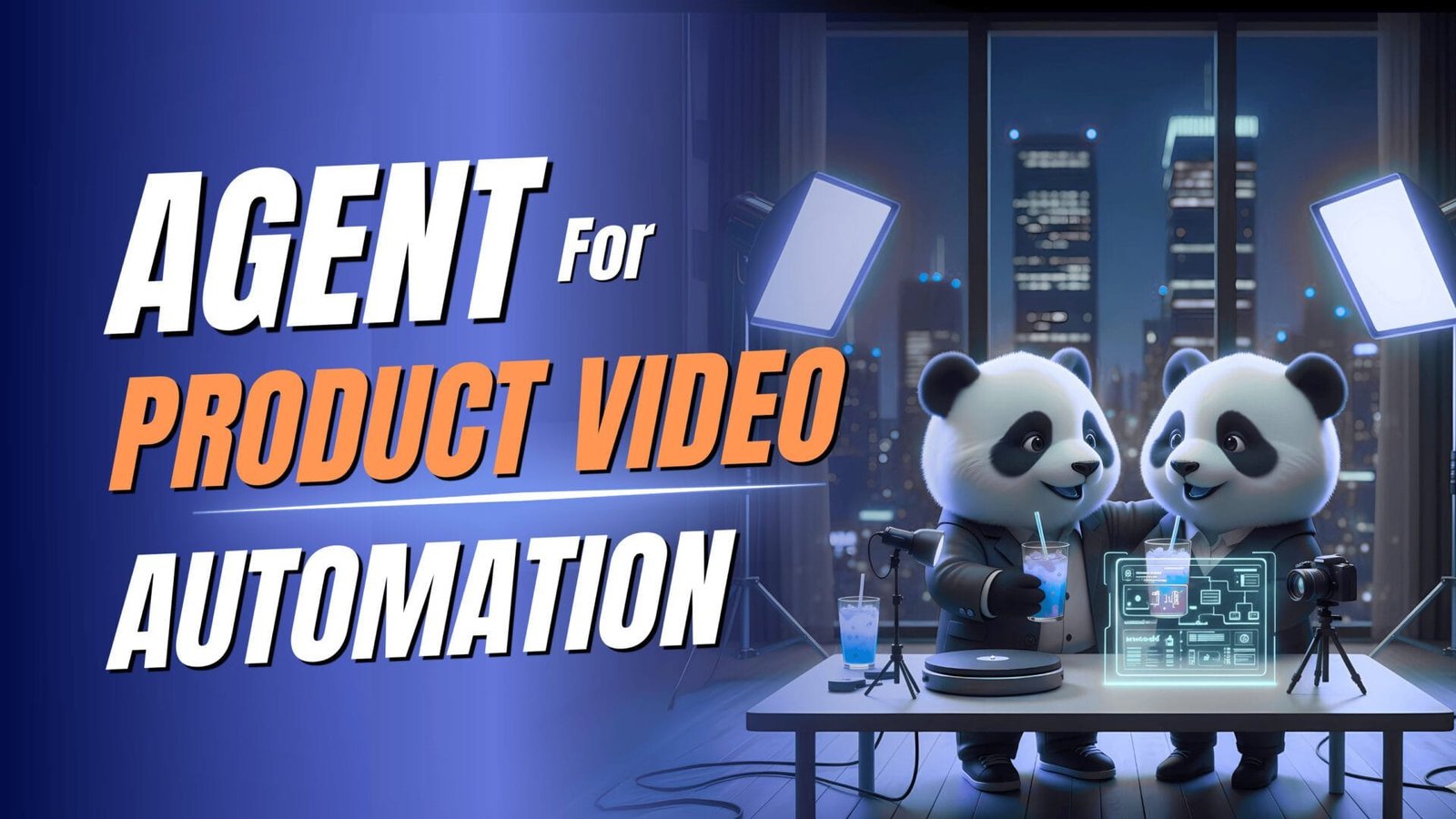
Automated Product Video Maker: Professional Visuals for Indian MSMEs Without Studio Costs
Product videos drive measurably higher engagement across ecommerce platforms and social media channels, yet most Indian MSMEs and startups struggle to produce them consistently. Professional videography requires studio rentals, specialized equipment, and experienced operators—investments that translate to substantial recurring costs when you’re building product catalogs with dozens or hundreds of SKUs. DIY approaches using smartphones and basic editing software produce inconsistent results that lack the polish customers expect when evaluating products online, while outsourcing to freelancers or agencies creates scheduling dependencies and variable quality that complicates catalog management. This gap between customer expectations for professional product presentation and the operational reality of resource-constrained businesses creates a competitive disadvantage where smaller companies appear less established than they actually are, simply because their visual content doesn’t match the production values of better-funded competitors.
For Indian ecommerce businesses, D2C brands, and B2B suppliers operating with limited marketing budgets, this automation represents a fundamental shift in what’s economically feasible for visual content production. A single founder or small marketing team can now generate professional product videos for entire catalogs in hours rather than weeks, with consistent quality across all products and formats optimized for different platforms from Amazon product listings to Instagram reels. The financial model changes from per-product production costs and fixed studio expenses to usage-based API fees and cloud processing charges that scale with actual volume, eliminating the capital investment barrier that previously made professional product videography accessible only to established companies with dedicated creative budgets. Ethical Founder builds these automation workflows specifically for Indian MSMEs who need enterprise-level visual content capabilities without enterprise costs or technical teams, focusing on practical implementations that businesses can deploy and manage themselves using their existing product photography and standard business tools.
How an Automated Product Video Maker Actually Works
Automated product video maker workflows operate through connected processing stages that each transform your source content in specific ways, beginning with image enhancement that serves as the foundation for all subsequent video generation. When you upload a product photograph—typically a standard product shot taken with decent lighting and a clean background—the AI image enhancement algorithms analyze the image characteristics including exposure levels, color balance, contrast ratios, edge definition, and background complexity. The enhancement process applies corrections to these elements systematically: underexposed areas receive brightness adjustments while maintaining highlight detail, color casts from mixed lighting get corrected toward neutral accurate product colors, soft edges become sharper through intelligent sharpening algorithms that enhance detail without creating artificial-looking halos, and backgrounds get isolated or removed entirely using segmentation models that distinguish product from surroundings.
This enhanced image becomes your primary product asset—a studio-quality photograph suitable for ecommerce platforms, social media posts, and marketing materials even before video generation begins.
| Aspect | Traditional Videography | Automated Video Maker |
|---|---|---|
| Process | Physical setup with lighting, camera, turntable; manual recording; video editing software | Upload photo; AI enhancement; automated rendering; system delivery |
| Equipment | Camera, lenses, lighting kit, backdrop, turntable, editing computer | Computer/phone for upload; processing happens in cloud |
| Time per Product | 30-60 minutes including setup, shooting, editing | 5-10 minutes processing time after upload |
| Consistency | Varies with lighting conditions, equipment settings, operator skill | Identical processing applied to all products |
| Scalability | Limited by studio time, equipment access, operator availability | Concurrent processing of multiple products; no capacity constraints |
| Cost Pattern | Fixed studio rental + per-hour rates + equipment depreciation | Usage-based API fees + cloud storage; scales with volume |
| Output Control | Complete creative control over every frame | Template-based output; consistent style with limited customization |
| Quality Ceiling | Very high—full cinematography possible | Good—professional product showcase within template constraints |
Why Indian Ecommerce Needs Automated Product Video Makers
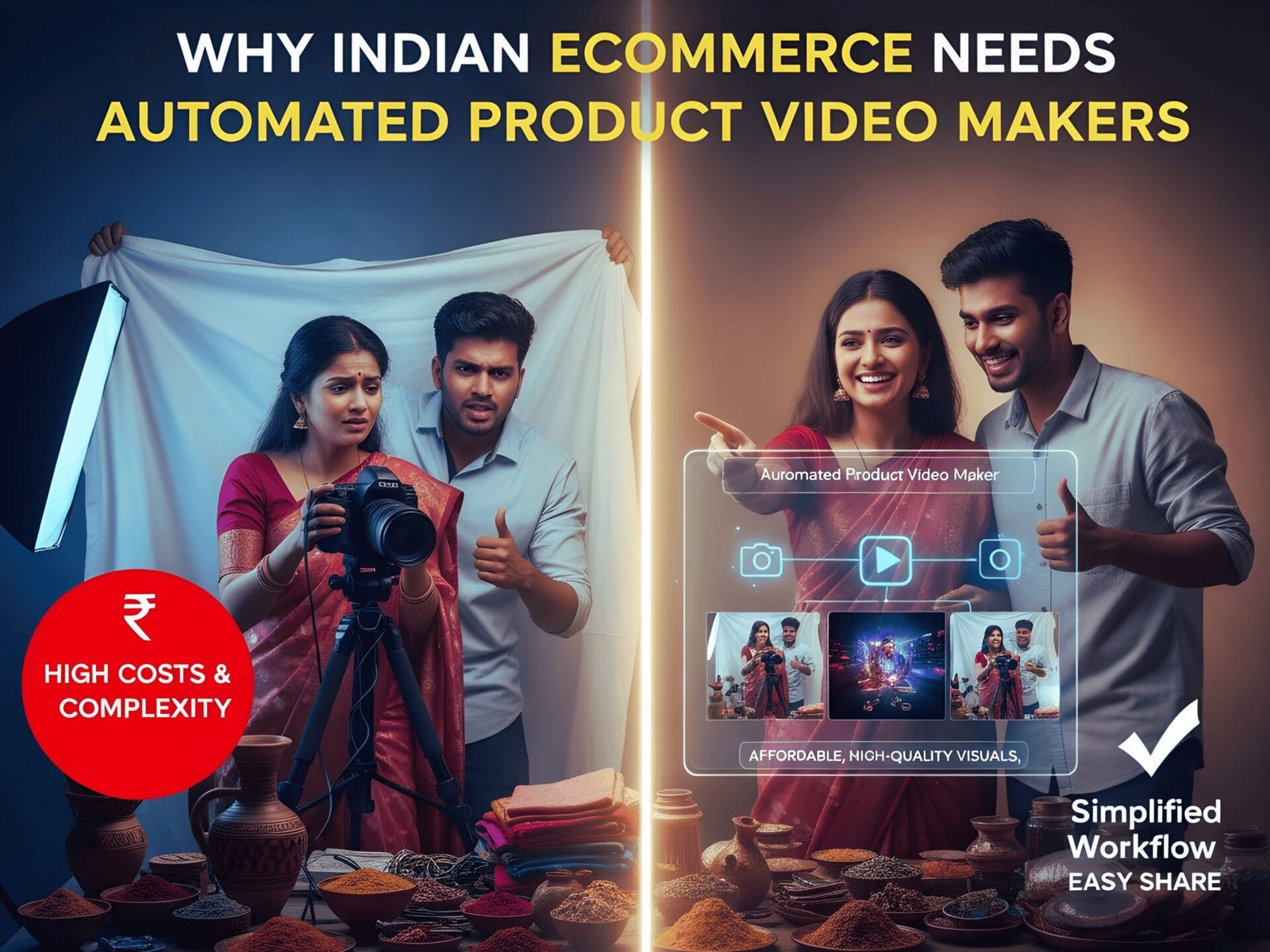
Ecommerce platform algorithms and customer behavior patterns strongly favor product listings with comprehensive visual content including multiple images and video. Amazon India’s search ranking algorithm considers content quality signals where listings with video content receive priority in search results compared to text and photo-only listings, all other factors being equal. Flipkart’s product discovery systems similarly weight visual content completeness when determining which products to surface for relevant searches.
Customer engagement metrics demonstrate measurably higher time-on-page, lower bounce rates, and improved conversion rates for products showcasing video content that lets shoppers examine items from multiple angles and better understand scale, texture, and features before purchase. These platform dynamics create competitive pressure where businesses with stronger visual content capture disproportionate visibility and sales compared to competitors with basic photography, regardless of actual product quality or pricing advantages they might offer.
Budget Constraints for Indian MSMEs
| Method | Setup Investment | Per-Product Cost | Time Investment | Scalability |
|---|---|---|---|---|
| Professional Studio | ₹50,000-2,00,000 equipment or recurring rental | ₹500-2,000 per product shoot | 30-60 min per product | Limited by studio time availability |
| Freelancer/Agency | None—pay per project | ₹800-3,000 per product | Scheduling + delivery time | Limited by vendor capacity |
| DIY Setup | ₹15,000-50,000 for basic equipment | Time cost only | 45-90 min per product | Limited by founder/team time |
| Automated System | API setup only | ₹50-200 per product in processing | 5-10 min per product | Unlimited concurrent processing |
The Technology Powering Automated Product Video Makers
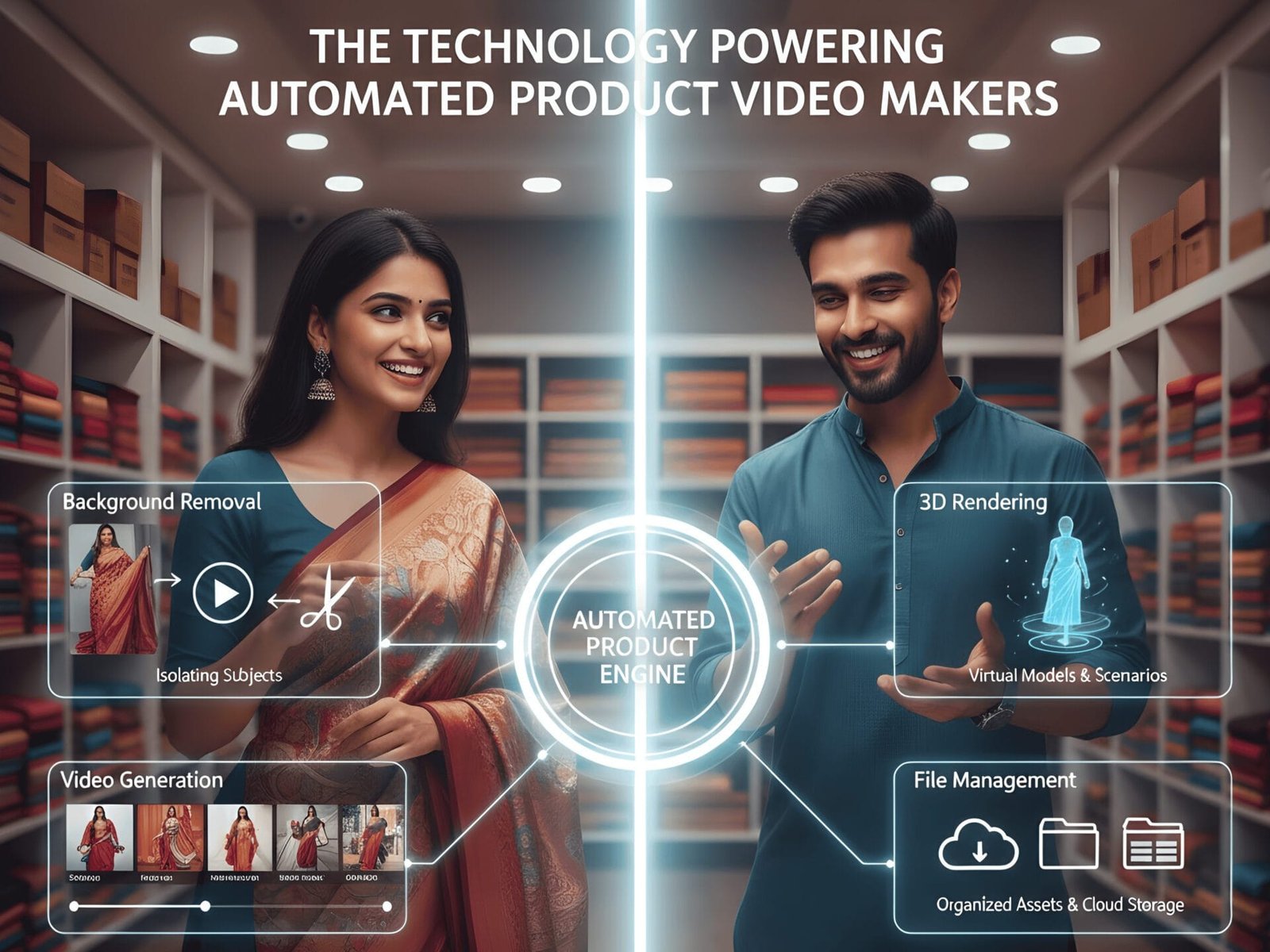
AI image enhancement powering automated product video makers uses machine learning models trained on millions of product photographs to recognize optimal visual characteristics and apply corrections that move source images toward professional quality standards. These models analyze your uploaded product photo across multiple dimensions simultaneously: lighting analysis identifies underexposed or overexposed regions and applies targeted exposure corrections that balance brightness across the product while maintaining natural shadows that provide depth perception; color correction algorithms detect color casts from mixed lighting or camera sensor limitations and shift the overall color balance toward accurate neutral representation that matches how products appear in properly color-calibrated environments; noise reduction processes identify and smooth grain or digital noise from high-ISO photography without destroying legitimate texture detail that customers need to evaluate product materials; and sharpness enhancement applies intelligent edge detection that increases perceived detail along product edges and surface features without creating artificial halos or over-processed appearances that signal heavy manipulation to viewers.
| Product Type | Photo Requirements | Enhancement Effectiveness | Video Quality | Best Use Case |
|---|---|---|---|---|
| Electronics/Gadgets | Clean edges, solid colors, good contrast | Excellent—clear boundaries enhance cleanly | High—simple forms rotate convincingly | Ecommerce listings, spec sheets, comparison content |
| Packaged Products | Clear labeling, distinct from background | Excellent—packaging text remains readable | High—box/bottle forms ideal for 3D | Amazon/Flipkart listings, wholesale catalogs |
| Apparel/Fashion | Flat lay or mannequin, texture visible | Good—fabric textures enhance well | Medium—flat items show less depth | Social media, catalog browsing, variant display |
| Jewelry/Reflective | Multiple light sources, high resolution | Medium—reflections complicate enhancement | Low—depth estimation struggles with complex surfaces | Use as enhanced photos; manual video may work better |
| Food/Organic Items | Natural lighting, color accuracy critical | Good—color correction improves appetite appeal | Medium—irregular shapes less convincing in 3D | Enhanced photos for menus; simple animation for social |
Implementation for Different Business Types
Ecommerce catalog businesses managing large SKU counts face the operational challenge of creating and maintaining visual content for hundreds or thousands of products across platform listings, marketing materials, and seasonal campaigns. Automated product video makers solve this scaling challenge by enabling concurrent processing of entire product lines—upload photos for your complete catalog, batch process them through the automation workflow, and receive standardized video content for every item without the sequential bottleneck of manual production. Integration with ecommerce platforms happens through standard file upload processes: take the generated product videos and upload them to your Shopify product pages through the admin interface, add them to Amazon Seller Central listings as supplementary video content, or embed them in WooCommerce product galleries through media library uploads. The consistency automated processing provides across your full catalog creates professional cohesion where every product receives identical enhancement treatment and video styling, making your entire storefront or marketplace presence appear uniformly polished rather than showing quality variance between products that signals unprofessional or inconsistent business operations.
Variant management represents a specific challenge for catalog businesses where single products exist in multiple colors, sizes, or configurations that each require individual visual representation. A clothing item available in eight colors needs eight separate product videos to properly showcase each color option; an electronics accessory sold in three size variants needs distinct videos demonstrating relative scale differences.
Automated processing makes this variant coverage economically feasible—photograph each variant once, process all variants through the same automation workflow, and maintain visual consistency across the complete option set. This comprehensive variant coverage improves customer purchase confidence by letting shoppers see exactly what their selected color or size looks like, reducing post-purchase surprises that drive returns and negative reviews. Platform best practices from Amazon and Flipkart explicitly recommend variant-specific visuals rather than single representative images, with their algorithms favoring listings that provide complete variant coverage in search ranking considerations.
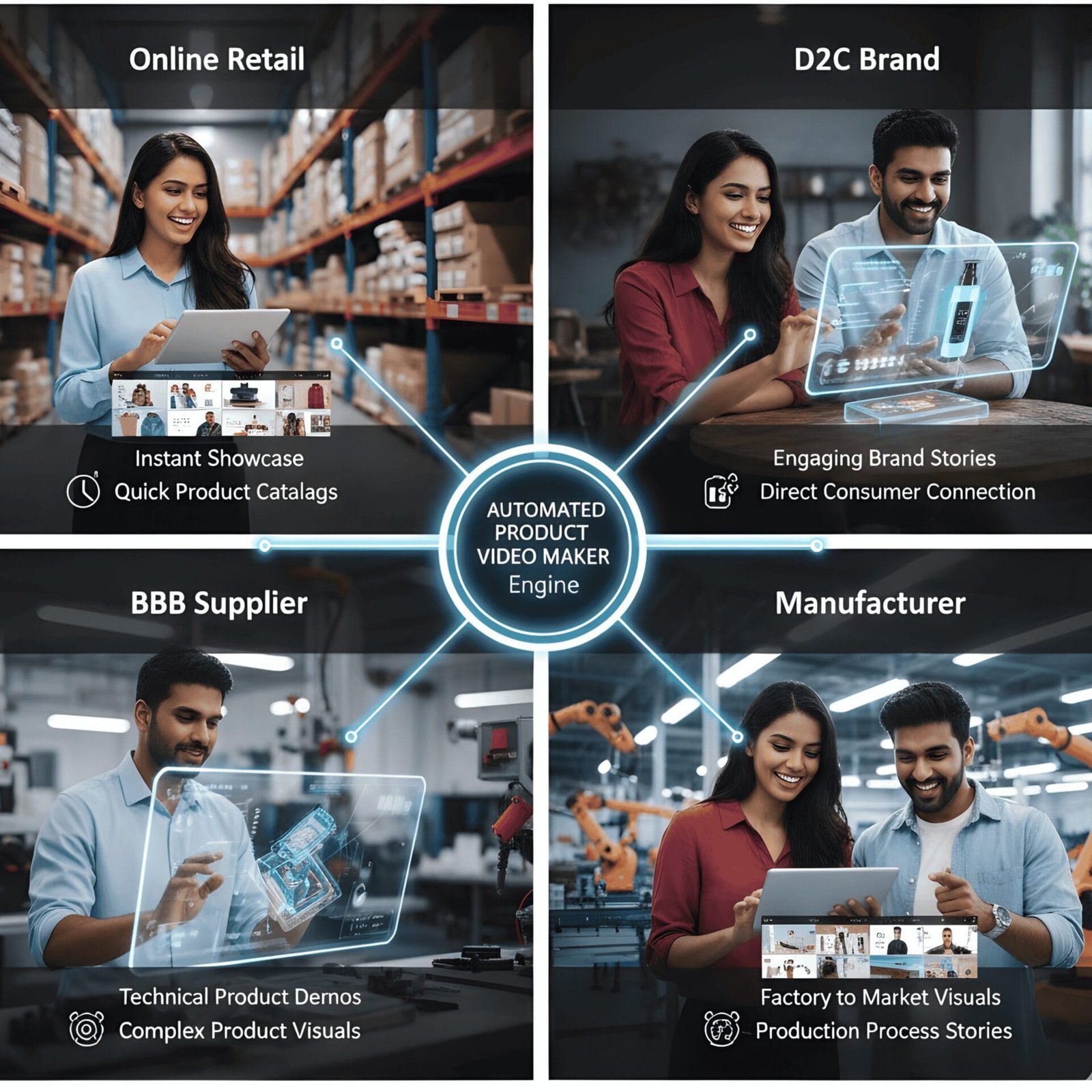
| Business Model | Primary Challenge | Automation Solution | Output Format Needs | ROI Driver |
|---|---|---|---|---|
| Online Retail (B2C) | Large catalogs, frequent additions | Batch processing hundreds of SKUs | Platform-optimized (Amazon, Flipkart, Shopify) | Improved search ranking, reduced returns |
| D2C Brand | Content volume for social channels | Rapid generation for campaigns | Multi-format (vertical/horizontal/square) | Social engagement, launch velocity |
| B2B Supplier | Professional perception vs competitors | Elevated catalog presentation | WhatsApp catalog, trade platform listings | Win rate against competitors, price premium |
| Manufacturer | Technical complexity, large product lines | Simplified visualization of complex items | Technical catalogs, export presentations | International buyer confidence, reduced explanation time |
Indian MSMEs competing in both domestic and international markets benefit particularly from automated product video makers because visual presentation directly affects perceived legitimacy in ways that disproportionately impact smaller businesses. Export buyers from developed markets expect professional product documentation and visual materials that signal operational sophistication and quality control capabilities. Domestic ecommerce platforms increasingly favor listings with comprehensive visual content in their search algorithms and featured product selections.
B2B marketplaces and trade platforms use visual content quality as filtering criteria when buyers search for suppliers.
We offer basic automation services at very low and affordable prices, ideal for startups and small businesses. Some advanced features are available only in our Custom Automation packages.
- If you choose the Basic Plan, we’ll provide complete documentation and setup guides so you can configure everything on your own.
- If you select the Custom Automation Plan, our dedicated team will support you from start to finish, ensuring smooth implementation.
- And if you go for the Premium Plan, we’ll build custom business-specific dashboards and train your team personally for a few days until they’re fully confident using the system.
- How to Check if Image Is AI Generated: A Five-Step Routine for Indian UsersCheck if image is AI generated in five steps: the SynthID detector, metadata, reverse image search, visual tells, and what India’s AI labels now mean.
- AI Labelling Rules In India 2026: What Creators and Small Businesses Must DoAI labelling rules India: what the IT rules amendment 2026 says about synthetically generated information, the ai label on Instagram, and a creator checklist.
- AI Product Images for Amazon and Flipkart: What Indian Sellers Can and Cannot DoAI product images Amazon India and Flipkart allow: which slots can use AI, Amazon image requirements for the main photo, and AI product photography without returns.
- AI Automation Services Pricing in India: How to Quote Without Underselling
 AI automation services pricing for Indian freelancers and agencies: how to price automation work by value, quote setup and support, and stop underselling.
- n8n Webhook Not Working? The Real Reasons and the Fix for Eachn8n webhook not working? Fix the n8n production url vs test url mix-up, the webhook not registered n8n error, and every n8n workflow not triggering.
- When a Small Business Owner Stops Doing Everything: My Evening Queue LessonMy own evenings were a queue with my name on every ticket. Here is the one decision table and the five-stage handoff I use with shop owners, so the day a small business owner stops doing everything is a decision, not a collapse.
- Business Ideas From a Family Complaint: How I Test Them After My IT ShiftMost business ideas start as a complaint at home. Here is how I turn a family gripe into cheap evening tests with strangers, an evidence ladder and a clear stop rule, before anyone spends money.
- Side Income vs Registered Business: What Changed When My Evenings Began EarningA salaried IT employee with evening clients explains side income vs registered business in India: how Udyam, GST and income tax ask different questions, and why I removed GST from my checkout.
- Word of Mouth vs Ads for a First-Year Business: Why I Paused My Own AdsI paused my own Meta ads to study what they were really teaching me. Here is how I compare word of mouth and paid ads in a first-year business, and the one-page ledger I now keep.
- Freelancer vs Business Owner Tax Identity: What Changes in IndiaFreelancer vs Business Owner Tax Identity: What Changes in India It is almost 11:30 at night as I type this,… Read more: Freelancer vs Business Owner Tax Identity: What Changes in India